
Baylor Scott & White Health — paid social for cancer screenings
Baylor Scott & White is one of the largest not-for-profit health systems in the country. These Meta ads were written to drive cancer screening appointments.
Screening advertising has a built-in problem: you’re asking people to schedule something they’ve been actively putting off, in a category where the obvious emotional lever is fear.
Not using the fear
Fear works in the short term and then people scroll past. Nobody books a colonoscopy because an ad made them anxious in line at the grocery store — they close the app.
Both ads open the same way: “It’s no secret: cancer screenings save lives.” That’s the least arguable sentence available. It doesn’t scare anyone and it doesn’t sell anything, which means the reader is still reading when the actual question arrives.
Making the reader the competent one
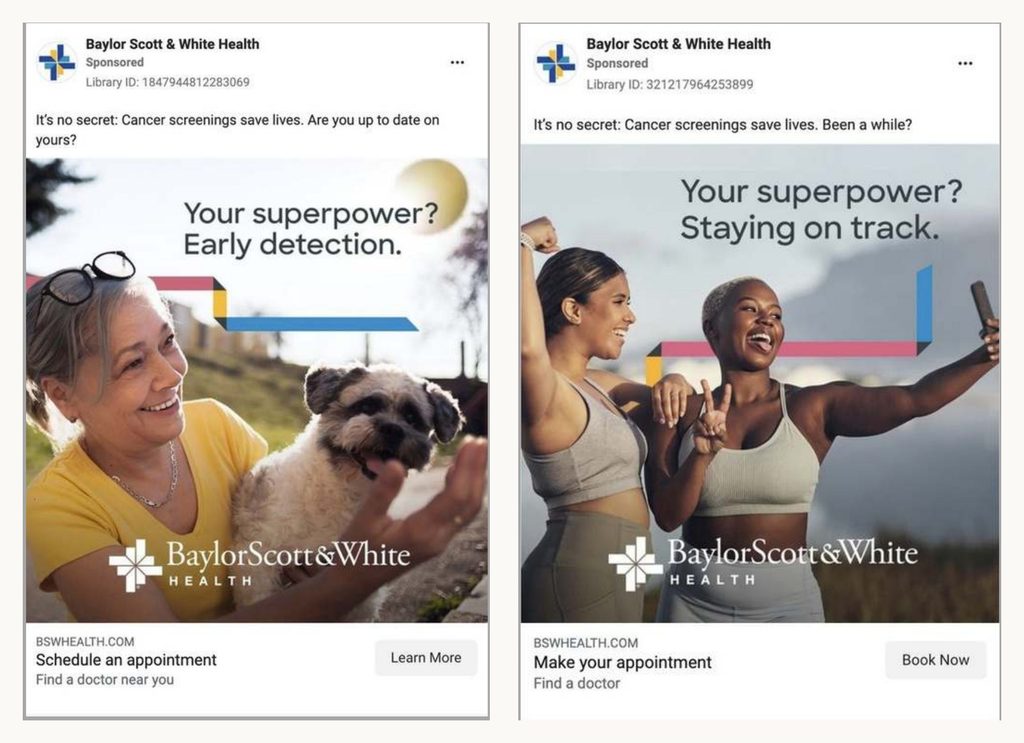
The creative line is where the work is. “Your superpower? Early detection.” and “Your superpower? Staying on track.”
Screening is an act of caution. Framing it as a superpower puts the reader in a different role — not a patient waiting for bad news, but someone doing something capable. That reframe is what gets the click, because it changes how the action feels rather than how the disease feels.
Same campaign, two readers
The body lines diverge on purpose.
“Are you up to date on yours?” is for someone who has never scheduled one, paired with an older woman and her dog.
“Been a while?” is for someone who is lapsed — shorter, more forgiving, no judgment in it. Paired with younger, active women.
Both are the same offer. One is an introduction and one is a nudge, and the ads know which is which.
What the claims can’t do
Regulated healthcare copy can’t promise outcomes. Screening doesn’t prevent cancer and no ad may imply it does.
So the promise is deliberately structured: screenings save lives, which is a population-level statement rather than a promise to the reader, and the rest of the copy is about the reader’s agency. The strongest thing you can honestly offer is a way to feel capable rather than anxious, which is what the copy sells.
A note on this piece
Written for Baylor Scott & White Health through an agency partner.