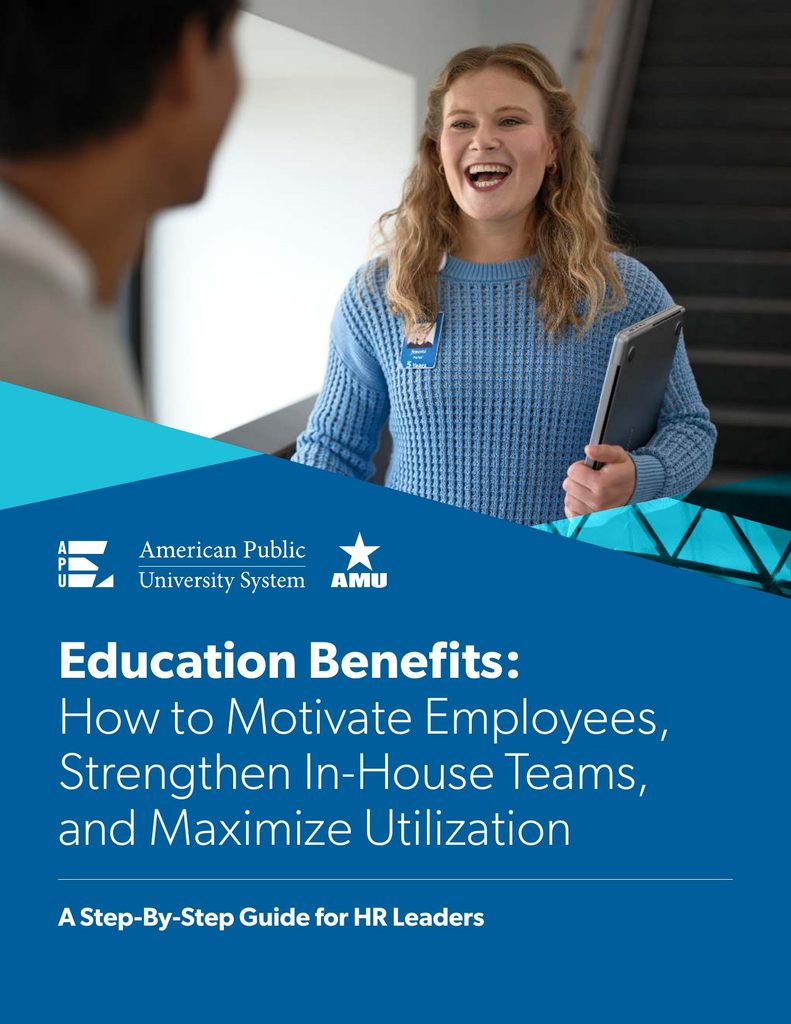
American Public University System — B2B print guide for HR leaders
American Public University System partners with employers who offer tuition benefits to their staff. The problem those partnerships run into is that the benefit often goes unused — people don’t know it exists, or don’t think it applies to them.
This eight-page print guide was written for HR and L&D leaders at partner organizations. The commercial goal was to get them talking to their APUS account manager. The guide had to earn that conversation rather than ask for it.
A resource first, or it doesn’t work
A piece like this fails the moment it reads as a sales document. HR leaders receive a great deal of vendor collateral and have a fast filter for it.
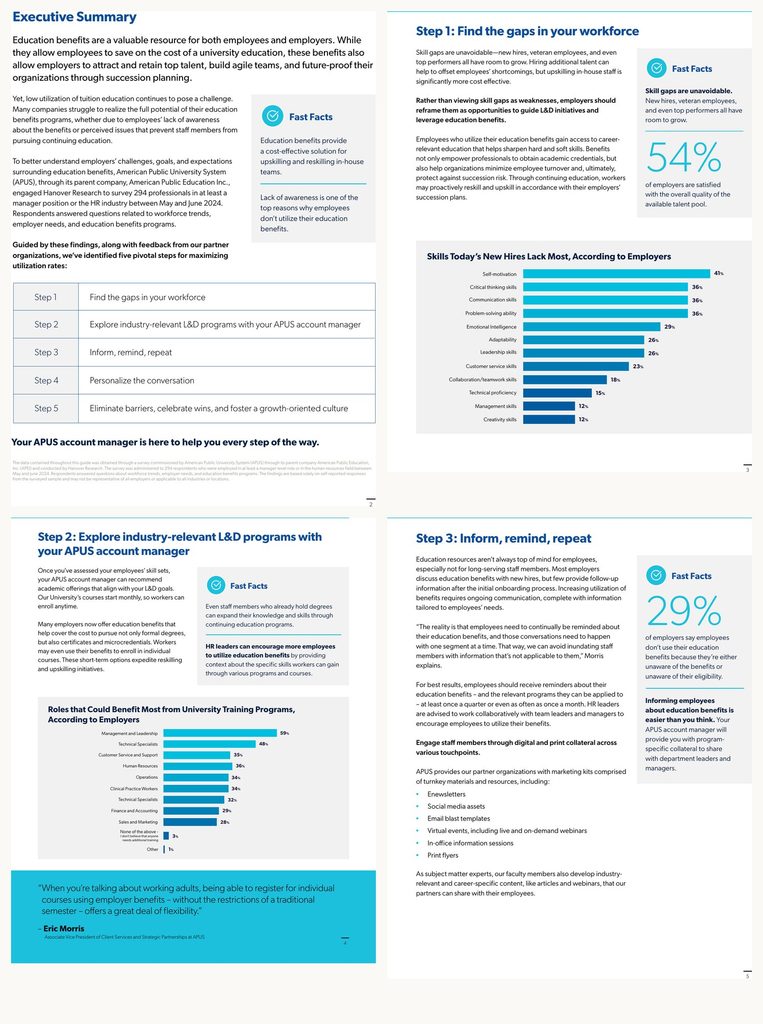
So the structure is built around the reader’s problem, not the client’s offering. It opens by diagnosing why education benefits go unused, then hands over things they can actually use: a five-step framework, scripts for performance review conversations, and a table pairing each common barrier with a solution.
The account manager appears throughout as the next step rather than the point. Step two is literally “explore programs with your APUS account manager,” which puts the sales motion inside the reader’s own workflow instead of at the end as an ask.
Using research without leading with it
APUS had commissioned survey research before I came onto the project. The easy version of this guide would have been a survey report — findings up front, headline statistic on the cover.
I used the data where it carried an argument instead. The finding that lack of awareness is a top reason benefits go unused sits next to the step about communication, because that’s where it does work. A reader who never looks at a chart still gets the argument.
Writing scripts people will actually say
The performance-review scripts were the hardest part. Scripts in vendor collateral usually read like nothing a human would say out loud, which makes them useless — a manager skims them, feels embarrassed, moves on.
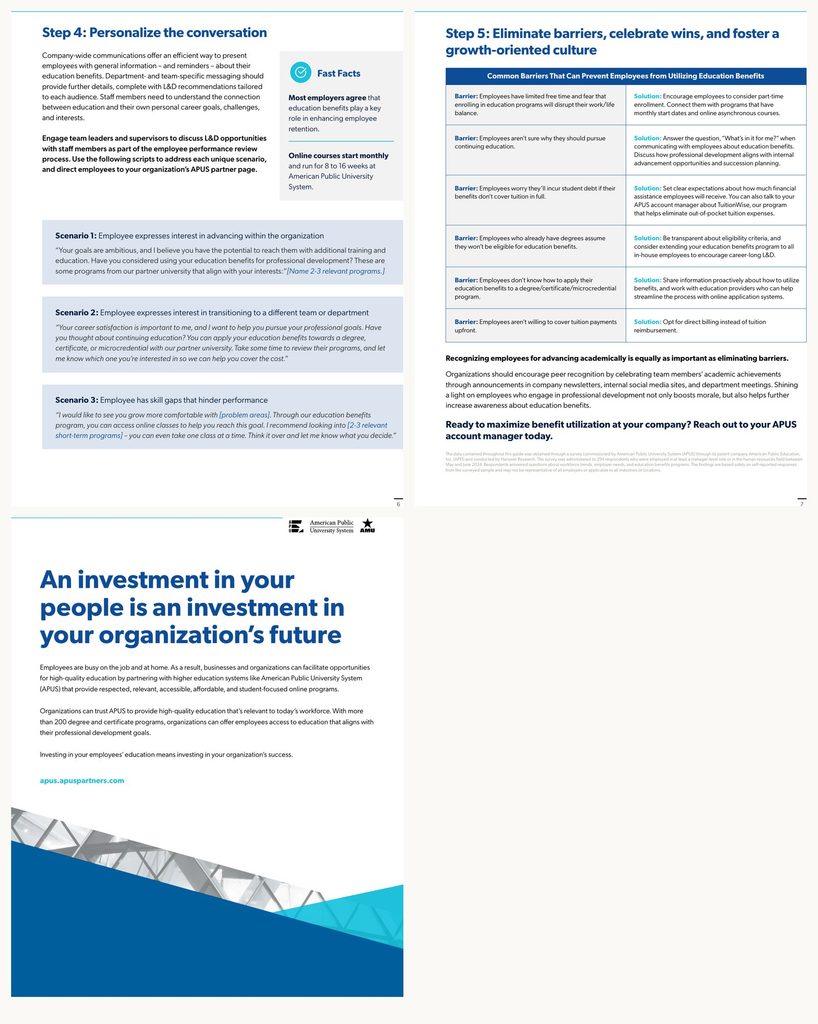
Three scenarios, each one a real situation a manager recognizes: someone who wants to advance, someone who wants to move teams, someone with a skill gap. The language stays in the register a manager would actually use in a review, with bracketed placeholders where the specifics go.
Print constraints
Print is unforgiving in ways digital isn’t. Nothing can be fixed after it ships, length is fixed by the page count, and a reader can enter on any spread rather than scrolling from the top.
That’s why each step works as a standalone unit. Someone who opens to step four gets a complete, usable thing without having read steps one through three.
A note on this piece
Written for American Public University System. The survey research was completed before my engagement; I built the outline and wrote the guide around the existing findings.