
American Military University — long-form web copy for Legal Studies
AMU’s area of study pages sit at the top of the enrollment funnel. Someone searching “what can you do with a legal studies degree” lands here, knowing they’re curious and not much else.
The page has to rank, hold the institutional voice, and be substantive enough that a prospective student actually reads it. Those three pull against each other constantly.
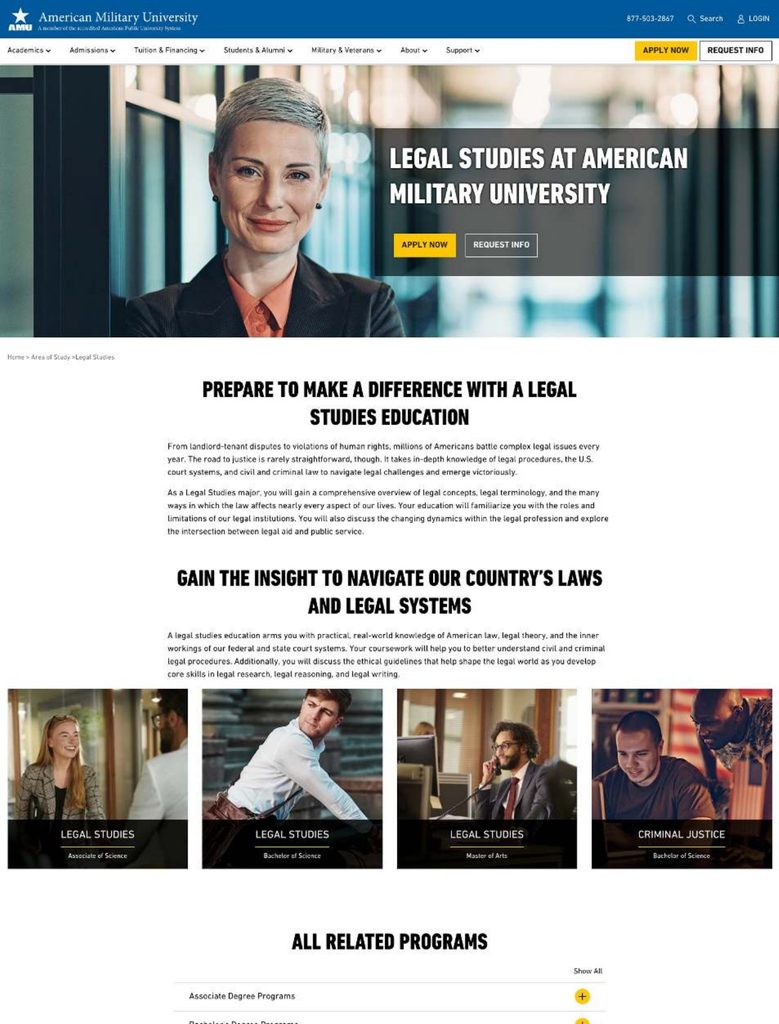
Writing for search without writing for search engines
SEO pages have a characteristic failure mode: they answer the query in the first paragraph, then pad to hit a word count, and everything after the answer is filler a human can feel.
This page is organized around the questions a prospective student actually works through, in the order they’d hit them. What the major covers. Whether it prepares you for law school. What careers it leads to. What makes it different from a law degree.
Each section answers one thing completely. That happens to be what search engines reward now, and it’s also just how you’d explain it to someone.
Citing sources in higher ed copy
Enrollment copy has a credibility problem: every school says its program prepares you for a great career, so the claim carries no weight.
This page cites instead. Bureau of Labor Statistics on career paths, the American Bar Association on what law schools actually want, the Legal Services Corporation on unmet legal need. The ABA citation is the useful one — it says law schools don’t recommend any particular undergraduate major, which slightly undercuts the sales pitch and is exactly why a reader believes the rest.
Giving a dry subject stakes
Legal studies could be described entirely in coursework terms and be accurate and unreadable.
The access-to-justice framing is what carries the page. Seventy percent of civil and family cases involve at least one self-represented party. Millions of people navigate legal problems without counsel. That gives the degree stakes beyond the career outcome, and it gives someone considering this program a reason that isn’t salary.
The FAQ section
The FAQ isn’t decoration. Those are the questions people type into search, phrased the way they type them, answered directly underneath.
That structure is what gets pulled into featured snippets and AI answers — which means this section was doing AEO work before most higher ed sites were thinking about it.
A note on this piece
Written for American Military University. Part of an ongoing engagement writing and editing program and area of study pages across APU and AMU.